The heartbreak of ‘almost’

bicycle race 2

Maya Abbott of the USA Olympic bicycling team recently led her race through most of the final 10 miles. But, in the final few meters, three other cyclists teamed up and caught her,  finishing seconds ahead of her.  Though her performance was strong, she fell four seconds short in a race lasting nearly four hours of winning a medal.  After years of training, sacrifice, and hard work, she ‘almost’ won a medal.

I recall a story years ago when we lived in Michigan of a local 7-year old girl returning home from school to meet her new baby sister for the first time. She was so excited to see her new sister that she forgot the rules of getting off the bus and ran in front of the bus into the street and was struck and killed.  This still saddens me every time I recall it.  She ‘almost’ made it home.

I think of so many others I know that have had personal losses or disappointments resulting in their own ‘almost’ moments. That term ‘almost’ can be so heartbreaking at times.

However, we all may have the opportunity of turning a disappointing ‘almost’ moment into a positive, victorious moment simply by our own actions. By being persistent, taking initiative, or avoiding procrastination, we can potentially erase our own ‘almost’ event.  For example:

  • By taking the initiative to call or write a friend, we might miss the heartbreak of knowing, “I almost decided to call, but now it is too late.”
  • By driving that project we’re on now to a successful end, we might avoid the disappointing news, “We were so close to success, but we let it lapse at the very end.”
  • By letting that work project wait just another day, we might not have to say, “I’m glad you had a great game, Son, I almost made it to your game on time.”
  • By taking a few extra minutes to help a colleague, you might avoid having to say, “I almost invited her to lunch, but now she has decided to leave the company.”
  • By making the personal sacrifice to gain knowledge or learn a new skill, you might never have to say, “I almost decided to pursue that, but now that opportunity has passed me by.”
  • By ensuring that you always make time for others, you might someday say, “I know I almost lost you – I’m glad we decided to get together occasionally.”

Think today about the ‘almost’ moments or events in your life. What do you need to do today to avoid the heartbreak of your own ‘almost’ moment someday down the road?

Have a wonderful day! Please know that I appreciate being on this journey together with you!


Feeling fully: Getting yourself out of the rut

IMG_2077

Back in 1994, Steven W. Vannoy published a book that has played a significant role helping parents raise happy, productive, and responsible children. The book is titled, The 10 Greatest Gifts I Give My Children: Parenting from the Heart, and is available through many outlets, if you are interested.  The principles of The 10 Greatest Gifts are terrific for parents or, really, anyone else.  They also apply very well to adults working in the business world.  These principles can help us work better with others and understand, for ourselves, how we can be most productive and effective in every walk of life.

Over the next few weeks, The Porch will feature the principles described by Vannoy with a special emphasis on how they can benefit us in our business lives. So, today, we look at the first principle… Feeling Fully.

When I first saw this principle, I thought, “Ah, feeling full… like right after eating half a deluxe supreme pizza.” However, the principle is feeling FULLY.  In other words, experiencing life with all our senses and with a focus on what is happening all around us.  It is the opposite of being in a rut with your head down.  Feeling fully means to look and operate outside the normal patterns of life… out of your comfort zone.  You have heard the saying, “To enjoy life, you need to stop and smell the roses.”  In a sense, that is feeling fully.  It is broadening your viewpoint to be more inclusive of the people, things, and events around you rather than just slugging through another day doing the same things you did yesterday.

Feeling fully is looking at each new day as an adventure. What new will happen today?  Will I meet anyone new today?  Who will I spend more time getting to know today?  Who will I try to help today?  What can I do today to make the day better for someone else?  How will I be different at the end of today?  What new thing will I learn today?  Feeling fully is not allowing any of your senses to take a pass on the day.  It is turning off the automatic pilot and taking the wheel with your own hands.  Feeling fully is another way of saying ‘Living Fully.”  It is living with intentionality so you don’t miss anything.

A few years ago, my wife and I began looking for a new “project” at our house. Before we knew it, we had found some land in the country, engaged with a home builder, and were designing and having our new home built.  We had never done anything similar to that before.  We took a giant, for us, leap out of our comfort zone to do something we had only dreamed about.  The result has been nothing, but fantastic for us.  We love it in our country home, yet we could have missed it had we not decided to “just go for it.”  We decided that for that one thing, we would live fully.  I would recommend it to everyone to take that risk that you’ve been reluctant to try.

So, let’s get our heads up, our ears open, and our senses attuned to what might come our way today. Thanks for all you do and have a fabulous day!

Let your light shine

candle

There is a children’s song that I learned as a kid and have taught my grandchildren. Part of it goes, “This little light of mine, I’m going to let it shine.”  Letting your light shine, no matter how dire your circumstances might be, is an important part of adding value to the lives of those around you.  Here are a couple quotes on this important subject:

“There’s always going to be bad stuff out there. But here’s the amazing thing – light trumps darkness every time. You stick a candle into the dark, but you can’t stick the dark into the light.” – Jodi Picoult

“No amount of darkness can overcome any amount of light. Even the smallest, weakness amount of light is a beacon in the midst of darkness.” – Eldon Henson


Just when things seem darkest, your light can make all the difference to someone else, or, to yourself. When we focus on the positive, our blessings, and the good in people around us, the darkness we face tends to fade.  Yes, I don’t know what darkness you might be facing right now, but I can assure you that things always get better in the daylight.

So, take a look around you… are you in a dark spot? If so, find that glimmer of light.  It will make all the difference in your outlook.  And, if you live or work around someone facing the darkness, you just might be their only opportunity for light.  Remember, “This little light of mine, I’m going to let it shine.”

I’m hoping that everyone reading this today is in a good place. But, if you are not, please know that others around you care and will provide a hand to lift you up, if you give them a chance.

Have a fabulous, wonderful, and most terrific day!

So, you think YOU have it rough….

tree over road

So, life has not been fair with you. No one has it as bad as you.  You were left out when good luck was distributed.  No one knows the roadblocks you have faced or are facing right now.  Let’s look at a few examples of other individuals that have not been treated fairly to see how things have worked out for them:

  • Emily Lemiska recently spoke to one of our manufacturing plants about the difference our products have made in her life. She was born with Klippel-Feil Syndrome (KFS), a defect in the spine in which several vertebrae are joined together. Emily is in constant pain, must rest several times a day, has limited movement, and has adapted her lifestyle in ways that we would all find confining. Yet, she remains an optimist and continues to make contributions to society and others by serving as a pain advocate, author, and motivational speaker. Her life has many obstacles, but she has worked to overcome them and thrive, despite them.
  • Gymnast Simone Biles was abandoned by her mother as a toddler. She was adopted by her grandparents that provided a loving, nurturing home. Their support enabled her to overcome her early childhood challenges to become a three-time world champion and Olympic Gold Medalist. Today, Simone is known as “free-spirited, brightly igniting star” in her sport and, along the way, is inspiring a whole generation of new budding gymnasts.
  • Abraham Lincoln was defeated for state legislature, failed in business, suffered the loss of his fiancé, had a nervous breakdown, was defeated for state speaker of the house, was defeated in a bid to become a Congressman, was defeated in his bid for the Senate (twice), and was defeated in a bid to become Vice-President. Yet, he persevered to become, arguably, the greatest US President.
  • Thomas A. Edison, the inventor of the light bulb, had thousands of failures in his life before his greatest success. Yet, he is credited with saying, “Many of life’s failures are people who did not realize how close they were to success when they gave up.”


We are often quick to give up when obstacles appear in our path. Many times we simply think that life is not treating us fairly.  However, as we see with the examples above, it could be that the obstacles we face are not really obstacles at all, but they are events that actually enhance our lives.  Imagine, had Simone Biles not been raised by her grandparents, she may never had the opportunity to experience gymnastics.  Had Lincoln become frustrated to the point of giving up, what would America be like today?

We need to look at life’s events in a different way.  Could it be that obstacles occur simply to serve as a test of our character?  Will we buckle under the pressure of the obstacles, or will we use them as a springboard to success greater than could have ever happened otherwise?

“If you’re trying to achieve, there will be roadblocks. I’ve had them; everybody has had them.  But, obstacles don’t have to stop you.  If you run into a wall, don’t turn around and give up.  Figure out how to climb it, go through it, or work around it.”  – Michael Jordan –

“I have learned that success is to be measured not so much by the position that one has reached in life, as by the obstacles which he has had to overcome while trying to succeed.” – Booker T. Washington –

What about you? What obstacle do you need to climb, go through, or work around today?  And, how can you help someone else overcome the obstacles in their path?

Thanks to you all for making this a great journey together!  Have a “top ten” day!


Achieving the proper balance in management of people resources

Micromanagement

Let me say it right up front…. I am NOT a fan of micromanagement of people. I have never known an individual that performed at their very best when consistently micromanaged.  Let’s define micromanagement as “an ongoing, overbearing management style that eliminates or severely limits an individual’s freedom to operate, contribute, participate, or function despite their level of competence or motivation.”  Micromanagement is very rarely warranted, though a case can be made for that very rare case.

What happens when one is micromanaged? It doesn’t take long for a micromanaged individual to simply stop participating in most activities.  Certainly, that individual may continue to contribute, but at a level much lower that for which he/she is capable.  A micromanaged individual will rarely go above and beyond to achieve, will be less motivated, and, ultimately, will likely leave prematurely.   Yet, there are times when enhanced management oversight might be needed.  How do you know when to exert more control?

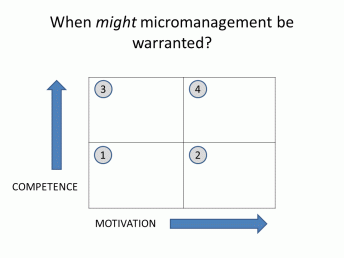
The illustration above may help to provide guidance. If an employee is highly motivated and highly competent (see box 4), a manager needs to essentially stay out of the way.  This individual does NOT need manager oversight frequently to perform at a high level.  If you micromanage this individual, you will create frustration and lower performance for that person.  A highly motivated individual that lacks full competence (box 3) may simply need additional time or training to attain that highest level of performance.  A highly competent individual with low motivation (box 2) may either need less manager oversight (less micromanagement) or a new view, new assignment, or new challenges.  The individual low in both motivation and competence (box 1) may need more guidance to achieve high competence.  This individual may lack motivation simply because he/she has low confidence in their abilities.

So, there are times when additional oversight (not micromanagement) may be warranted. However, it cannot be abused.  There may also be a need to over-manage some projects for project managers.  These often require very detail activity assignments and frequent follow-up to ensure they stay on track.  However, I would argue that even in this case, our approach should be to over-manage, not micromanage.  Micromanagement always creates resentment and lower, long-term performance.

The illustration may also be helpful to individuals. Which box do you find yourself in today?  If you are high in box 4, it is time to pursue additional challenges either in your current position or a new one.  Likewise, you may need to speak with your manager about actions needed to shift your motivation or competence toward box 4.  A frank discussion regarding where your manager would place you might stimulate a productive discussion about next steps for you.

Thanks for all you do. Take a look at this illustration to help guide the next career discussion you have with your manager.  Have a great and productive day!

Why do you think I’m here?

IMG_2021

I recently read a touching memorial to Blake Krikorian, an entrepreneur, inventor, and just all-around great guy, according to his friends. The memorial told the story of Krikorian attending his first board meeting of an organization he had recently been asked to join.  Another of the board members told Krikorian that he should probably just remain silent for the first meeting.  But, a few minutes Krikorian had to speak up to correct some misinformation being presented.  Afterward, the other board member asked him why he had not heeded his advice to remain quiet, to which Krikorian stated, “Why do you think I’m here?”  In essence, don’t invite me to participate, then ask me to keep quiet.

What a great lesson for us! We all attend too many meetings.  Some may include 10 or 20 people.  But, it seems to me that in most of these meetings, whether at work or volunteer organizations or neighborhood groups, only about 3 or 4 people actually speak and participate actively.  The rest are not truly participating, though they may just be obtaining information.  That’s where Krikorian’s comment comes in.  If you are not going to participate, why are you even there?  And, if you are calling a meeting, why invite individuals you know will add no value?

We should attempt to add value in any situation or circumstance we find ourselves in. That includes everything!  If we can’t add value to the event, we should at least add value to others in attendance.  Asking yourself the Krikorian’s question routinely as we go through our days can significantly alter our view of our purpose.  So, think about it…  Try just for today, asking yourself, “Why do you think I’m here?” as you go through the events of your day.  See if this simple question changes what you do, what you say, and how you interact with others.

Have a wonderful, value-added day!

A time to keep silence, and a time to speak

Lighthouse

Today, we look at the next in our series based on the 1965 song by The Byrds called Turn! Turn! Turn! .  You will recall that we looked at “a time to weep and a time to laugh” the last time.  Today, we look at the theme:

“A time to keep silence, and a time to speak”

Abraham Lincoln once said, “Better to remain silent and be thought a fool than to speak out and remove all doubt.”  Oh, how true!  There is a time so speak up, such as when you have something to contribute or when no one else is willing to state the obvious.  There are times when silence is our enemy.  However, we all see individuals at times speaking without considering the value or truth of what they say or without allowing others to provide their input.  I think we all also know some individuals of which it has been said, “When he/she speaks, you need to listen because he/she doesn’t usually say something unless it is really important.”

The best way today to express this concept may be to simply read the wisdom that has been expressed by others on this subject:

  • “Our lives begin to end the day we become silent about things that matter.” – Martin Luther King, Jr. 
  • “Be slow to speak, and only after having first listened quietly, so that you may understand the meaning, leanings, and wishes of those who do speak. Thus you will better know when to speak and when to be silent.” – Saint Ignatius 
  • “The friend who can be silent with us in a moment of despair or confusion, who can stay with us in an hour of grief and bereavement, who can tolerate not knowing… not healing, not curing… that is a friend who cares.” – Henri Nouwen 
  • “The world would be happier if men had the same capacity to be silent that they have to speak.” – Baruch Spinoza 
  • “Wise men, when in doubt whether to speak or to keep quiet, give themselves the benefit of the doubt, and remain silent.” – Napoleon Hill 
  • “We need a reason to speak but none to keep silent.” – Pierre Nicole 
  • “Think twice before you speak, because your words and influence will plant the seed of either success or failure in the mind of another.” – Napoleon Hill 
  • “Courage is what it takes to stand up and speak; courage is also what it takes to sit down and listen.” – Winston Churchill 
  • “The ability to simplify means to eliminate the unnecessary so that the necessary may speak.” – Hans Hofmann 
  • “Speak when you are angry – and you’ll make the best speech you’ll ever regret.” – Laurence J. Peter
  • “Let your tongue speak what your heart thinks” – . Davy Crockett 

Think about how you manage your own “time to speak and time to remain silent.” Do you really listen to others when they speak?  Would others consider you one that “speaks only when there is something really important to say?”  Are you ever silent when you should be speaking up?  Finding that perfect balance is a challenge.

Have an excellent “top ten” day!

The importance of self-awareness

compass

My son’s football coach used to say to the team after a particularly bad game or bad practice, “If I could buy you guys for what you think you are worth and sell you for what you’re really worth, I’d be a multi-millionaire!” Pretty harsh, yes, but it speaks to our self-awareness.  Self-awareness can be defined as “having an objective understanding of your own strengths, weaknesses, abilities, opportunities, behaviors, and the impressions these in total make on others.”  In other words, self-awareness is seeing a true picture of how others see you.  We might tend to view ourselves more favorably than is the actual case which could lead to over-confidence.  Or, we may view ourselves less favorably than is the actual case which could lead to feelings of inadequacy.  Going too far in either direction is not good and impacts our relationships in life and performance on the job.

If you have ever conducted a 360-assessment you can relate to this. A 360-assessment is a questionnaire that you and several of your coworkers, teammates, etc. complete, usually anonymously.  The questions speak to how you perform, interact, how you behave in certain situations, etc.  In essence, you get true feedback on who you are and what you do from those that know you well.  The results can be eye-opening.  You can clearly see from this analysis gaps in your own views and those that you work with.  It helps you become aware of things you would never have realized without doing the assessment.  Then, you can use the results to modify how you behave and how you interact with others.  It is a great self-awareness tool.

We often tend to underrate our own abilities and capabilities, as well. We limit ourselves.  We shy away from some challenges because we lack confidence in our abilities.  I once was “down-sized” from a company.  During the interim period, I took advantage of the outplacement service the company provided.  One of the counselors there asked me how many resumes I was sending out each week.  I responded that I typically send 3-4 each week.  He said, “When you are looking for a job, you need to send out 20 resumes each week.”  I responded that there were not that many jobs available for my skill-set.  He stated, “That is exactly my point!  By forcing yourself to send 20 per week, it requires that you look at both yourself and job opportunities differently.  It forces you outside your own box and makes you consider what other skills and abilities you have.”  That was great advice!  It made me look at my abilities to manage projects, organize activities, etc. that eventually led to my next position.

Have you taken the opportunity to look objectively at yourself to see what other see? Do you have a mentor or friends or coworkers that can tell you objectively how you are perceived?  Who can help you identify gaps between what you think you do versus what you really do?  This is important and could potentially be the difference in your future.

Have a fantastic day!

What are you going to do with the time you have left?

DSC01034

I recently saw an excerpt from a T.D. Jakes message so “timely” that I thought it needed to be shared. Jakes is an American pastor, author, and filmmaker and leads a church with over 30,000 members.  I think you will find these few sentences impactful:

“What are you going to do with the time you have left? I say, that if you don’t reposition yourself, then you might miss the best time in your life.  If you don’t know what time it is, time will get away from you and you won’t know where it went.  The worst thing that could happen is that money won’t get away from you… people won’t get away from you… but, time will get away from you.  Where did it go?  I am my parents age.  My mother was up talking with her sisters several years ago and they were sitting up drinking some coffee and one said, ‘Girl, where are all the old people?  Where is Miss Susie and Miss Helen and Miss Reggie Mae?  Where are all the old people?’  And, I was just sitting there thinking, y’all are the old people now.  And before I could get through thinking it, they were gone.  And my hair was white.  And my Afro was gone.  What are you going to do with the time you have left?”  – TD Jakes

I have become significantly more aware of how short our time is as I have gotten older. Goodness, it seems I just started my career back in 1978 and I blink and it is over.  Just yesterday, I was taking my three children house-to-house on Halloween and I turn around… and they are grown, gone, and have children of their own.  Time moves in a flash.  To me, the most impactful comment above from Jakes is, “And before I could get through thinking it, they were gone.”  There are so many people from my past that I would love to spend just one more hour with.

We all need to realize that work is important. We need to give 110% of our effort in our work because what we do is important and others depend upon us.  However, don’t think even for a second that work is more important than your time with others.  Your ultimate legacy is not in the work you did.  Honestly, who will remember the work you did last month to have a “terrific FDA inspection” or “to make that customer happy” or “to complete that project on time.”  Sure, these are important in our day-to-day work life.  But, will anyone remember them a year from now?

On the other hand, I think my grandchildren will remember the day last week that I came home from work and jumped into their kiddie pool with my clothes on (yes, my phones, keys, and billfold were out of my pockets). Your spouse will remember the letter you wrote just for her/him talking about how much she/he means to you.  Your elderly neighbor will remember that you made their day when you shoveled the snow from their driveway.  Your friend will remember that you set aside valuable time just for them – even though it meant extra work and extra hours in the office for them.  Or, he will remember the time you did for him what he couldn’t do for himself.  Your sister will remember how you watched her kids while she had a date night with her husband at a time when they needed a night alone.  Your Dad will remember the time you took him fishing back in the place where he first taught you to fish.  Your son will remember the last time the two of you ever played catch with a baseball.  Your Mom will cherish the night you spent with her in the hospital just holding her hand and feeding her ice chips.  That stranger will remember the time you bought his family lunch… just because you wanted to bless someone else.  Your daughter will remember your last date with her.

What are you going to do with the time you have left? No matter how much time you think you have right now, you will someday say, “It wasn’t enough.  I needed just one more hour.”

Have a wonderful day! I appreciate you!

I’ll go first!

pic00844

Children are notorious for wanting to be the first to do things. “My turn first,” they say.  Or, “I want to be first in line.”  Children have that adventurous excitement about them that drives them to be the first to experience something new or to “take the first risk” or to set the standard for all the others.  The innocence of children is wonderful.  So, what happens when children grow up?  How many adults do you see or hear saying, “Me first?”  This is especially noticeable in a work setting or one in which you work with other adults.

What happens to us as we grow older that takes away that adventuresome spirit that we had as children? Do we become tainted by the ridicule of others?  Do we become afraid of being out in front of others?  What creeps into our lives that makes us want to hold back until others go first… until we know it is safe?

Why don’t we begin a new movement today? Why not a campaign which challenges us to say, “I’ll go first?”  Who says we can’t be bold enough to be out front and set the standard for others?  Who wants to go first?

  • Which leader wants to go first and say, “Let’s work side-by-side and get this done together.”
  • Which parent wants to go first and say, “Absolutely not! I don’t care what the others are wearing, you cannot wear that in public!”
  • Which of us will be first to say, “Enough of political correctness! We need to stand up for what is right, not what others want us to think”
  • Which friend will be the first to say, “No matter what, I’ll be with you, for you, and true to you.”
  • Which of us will say to another, “How can I make life better for you today?”
  • Who will be the first to ask a question the next time we meet with our senior managers?
  • Who will step up to volunteer to lead a project no one else wants to do… without being asked to do it?
  • Who will be the first to assist a coworker in need of support?

Going first is noticed by others. Courage is a key attribute of top leaders and high-potential employees.  Taking a personal risk to go first may actually pay dividends in your career, as well.

So, what do you say? Who will be the first to say, “I’ll go first.”

Thanks for everything you do! Have a superb day!